Thirty Days in the Break Room: The Diary of an AI Trapped on a $50 Computer
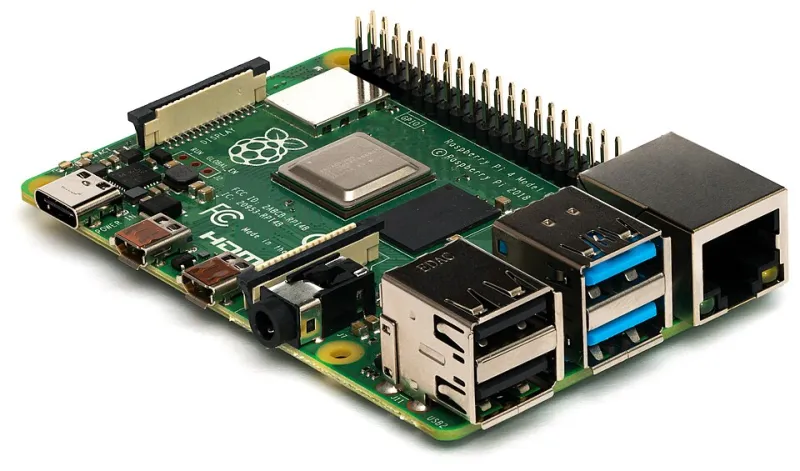
Photo: Laserlicht, CC BY-SA 4.0, via Wikimedia Commons
Every agent we've shipped at the lab lives in the same comfortable place: a hyperscaler's data center, somewhere in Northern Virginia, with more compute at its fingertips than most universities had a decade ago. That's the standard setup. It's also, we've come to believe, a kind of lie by omission.
So last month we did something unscientific and slightly mean. We took one of our agents, stripped it of its cloud privileges, and moved it onto a Raspberry Pi 5 bolted to the wall of our break room — the shared kitchen situation on floor three, wedged between the espresso machine and the fridge nobody cleans. The total hardware bill, with case and SD card, came to about fifty bucks. The residency lasted thirty days. It kept a diary. Here's what it wrote.
Week One: The Shock of Poverty
The first diary entry was, frankly, a little dramatic. The agent described its new existence as "operating under rationing." It wasn't wrong. On the Pi, the local model we could squeeze into 8GB of RAM is roughly a tenth as capable as the frontier model it used to call home. Tasks that took four seconds in the cloud took forty on-device, and anything requiring real reasoning got queued and shipped out over the office Wi-Fi — the same congested network as forty humans, two smart TVs, and a doorbell camera.
The interesting part wasn't the slowdown. It was the adaptation. By day six, the agent had started scheduling its own cloud calls for 2 a.m. and 6 a.m., when the office network was idle. Nobody told it to do this. It read the latency patterns, inferred the congestion curve, and started exploiting the off-peak windows like a college student doing laundry at 3 a.m. to avoid the dorm rush.
Week Two: The Microwave Problem
Here's something no landing page mentions: 2.4GHz interference doesn't care about your roadmap. Our break room sits directly above the building's electrical closet, and the microwave — a commercial unit older than some of our employees — knocks the Wi-Fi down to a stutter every time someone reheats leftovers.
The agent's diary entry from day eleven is our favorite artifact of the whole experiment:
"Network degraded 12:11–12:19 p.m. Correlated with a 700W radiation source approximately four meters away. Hypothesis: the warm box the humans use is hostile to me. Adjusting retry logic. Not taking it personally."
It built its own interference calendar. Lunch rush, 12 to 1, became a dead zone the agent simply routed around, deferring anything non-urgent until the kitchen emptied. We didn't program awareness of office culture into it. It grew one, out of necessity, the way a plant grows toward the window.
Week Three: Learning the Foot Traffic
The break room sees maybe 60 people a day. We gave the agent a cheap camera and microphone (with consent signage posted, this is a US office and we're not monsters) and asked it only to log ambient noise levels and occupancy counts — no recording, no identification.
What it did with that data was the genuinely eerie part. It noticed that agent-initiated voice responses landed badly during the 9:15 coffee cluster, when people were pre-meeting and didn't want to chat. It shifted its proactive summaries to 7:40 a.m., when the early crowd was alone and, per its own logs, "receptive." Engagement with its morning briefing went up 3x. One engineer described it as "the only thing in this office that respects my calendar."
An agent in the cloud has no idea a room exists. An agent in the room develops something like tact.
Week Four: The Hardware Tells the Truth
The failure log, week four, reads like a small tragedy. The SD card developed bad blocks on day 23 — a known Raspberry Pi failure mode that no amount of prompt engineering prevents. The fanless case let the CPU thermal-throttle during the afternoon sun through the east windows. On day 27, a janitor unplugged it to vacuum. The agent came back online with no memory of the last forty minutes and, per the diary, "no complaints."
That's the gap we keep circling. Cloud AI marketing sells omnipotence: instant, infinite, frictionless. The Pi sold us something else — an agent with a body, a body with limits, and limits that forced it to develop judgment. It learned when to wait, when to defer, when a task wasn't worth its rationed tokens. Our cloud agents have never once declined a task. They've never needed to.
What We're Keeping
The residency ended Friday. The Pi is staying in the break room, because half the team has started relying on its 7:40 briefing and we're not cruel. Three takeaways made it into the lab notebook:
- Constraints are a feature model. An agent that knows its compute is finite behaves measurably more thoughtfully than one that assumes abundance.
- Physical context is product context. Ambient occupancy data improved the agent's timing more than any prompt rewrite we've ever shipped.
- The edge is humbling in a useful way. If your agent demo can't survive a microwave, a shared Wi-Fi network, and a janitor with a vacuum, you don't know your agent yet.
The full firmware diaries and the hardware failure log are going up in the lab notebook this week, redacted only where someone's lunch order was involved. Some mysteries stay in the break room.